
Oregon has a long, proud history of health system transformation, dating back to 1989 with the creation of the Oregon Health Plan (OHP). For over 30 years, Oregon has been on the cutting edge of innovation, leading the nation in our willingness to challenge underlying assumptions, and to honestly explore the difficult questions involved with efforts to ensure access to health care in a world of finite resources.
Today, the framework of our health system innovation stands at a crucial point in its evolution. Not only have we strayed from the vision that guided the creation of our Coordinated Care Organizations (CCOs) in 2012—both in terms the rate-setting process and in an erosion of the spirit of collaboration which underlies true innovation—but there is also uncertainty about the future of one of the foundational elements of the OHP, the prioritized list, around which we have built the covered benefit for over three decades.
Of equal concern, is the fact that there is virtually no institutional memory, in either the legislature or in the Oregon Health Authority, regarding the debate that led to both the OHP and our CCOs, or of why these policies were enacted in the first place. Furthermore, over the past decade there has been a significant turnover in the leadership in Oregon hospitals, health plans and CCOs. For these reasons, it may be useful to provide some context for our health care system in 2024, a common understanding of how and why the Oregon system developed the way it did.
Let me start with the origin story of the OHP itself. Fifty years ago, this month, I began my career as an emergency physician in Roseburg, Oregon. I was 27 years old and just four months out of my internship and, quite honestly, a bit intimidated by my new responsibility. What I remember the most about the people who came to see me, was how vulnerable they were. They were sick or injured, frightened and asking for help. They didn’t know me and yet had put their trust, and in some cases their very lives, in my hands. It was an awesome responsibility and one I took seriously. I did everything I could to help them, used everything available, all the technology I could get my hands on, regardless of the cost. It’s what they expected of me and what my profession expected. It is what society expected.
Even then, sometimes I failed—and on those occasions when I was unable to save a life, I would walk across the hall. The hall ran in from the ambulance ramp and opened on the right through big double doors that led into the ER itself. On the other side of the hall, directly across from the ER, was a smaller room equipped with a couch and some chairs, and where the families and friends of those who arrived at the hospital by ambulance waited for news of their loved ones.
Walking across the hall became an almost ritual acknowledgement of failure for me—or so it seemed at the time. It always felt like a long, lonely journey to cross the thirty feet of tiled floor, carrying nothing but bad news and compassion, to tell someone that their husband or father or daughter—who had come to me for help—was gone.
This poignant intersection between compassion and human mortality is one of the most difficult aspects of practicing medicine. And yet, it is the very compassion and caring and humility involved that drew me into medicine in the first place.
When I was in medical school in the early 1970s, I was taught—and still believe—that at the heart of medicine lies a very personal relationship, an individual relationship between a doctor and a patient. As a result, medicine is practiced in a kind of “bubble,” one which encompasses the provider and the individual seeking care. Treatment decisions are made within the vacuum of the bubble, one person at a time, one life at a time—regardless of the cost involved— as though those decisions have no consequences beyond the sanctity of the relationship.
I would probably have continued to practice in the splendid isolation of this bubble had I not been elected to Oregon legislature in 1978—and for the next decade, I practiced medicine and served in the legislature at the same time. This experience brought me face-to-face with the inherent contradiction between my role as a physician and my role as a legislator. As a physician, I believed that my responsibility was to do everything I could for the individual before me, regardless of cost. As a legislator, however, I couldn’t ignore cost, and I believed that my responsibility was to get the greatest health benefit, for the greatest number of people, with the resources that I had available.
What I learned was that, while you can practice medicine one individual at a time, you cannot develop an equitable and sustainable social policy, one individual at a time. The goal is to balance the needs of individuals with the needs of the larger society—what my parents used to refer to as the “common good.” The goal is to try to maximize the benefit across the population.
This contradiction in responsibilities became painful clear to me in 1986, while serving my first term as Senate President. In those days, the legislature met only every other year—and during the interim between sessions, a legislative Emergency Board, co-chaired by the Speaker of the House and the President of the Senate, managed the state’s fiscal affairs.
In the spring of 1986, during the interim following the 1985 regular legislative session, the state budget fell out of balance by some $35 million, nearly half of which was due to unanticipated cost increases in the Medicaid program. At its May 1986 meeting, the Emergency Board acted to fulfill its constitutional responsibly to rebalance the budget. To do so, we reduced state reimbursement rates for doctors and hospitals by over a million dollars, and changed income eligibility criteria for the Medically Needy program, thus excluding some 4,300 poor Oregonians from state health care coverage.
I remember being astonished at how easy it was. We sat in a hearing room on the first floor of the capitol building with a lovely spring day going on outside the windows. We looked at some numbers on a piece of paper, we took some votes, and almost without effort, we produced a balanced budget—and, in the process, eliminated health insurance coverage for over 4,000 Oregonians. To most of the board members, it was simply a sterile budgetary exercise. To me, however, it was somehow disquieting.
Five months later, when I was back practicing in the ER in Roseburg, I begin to see some of the people who had lost coverage because of that decision. One was a middle age man with a history of hypertension, who I will call Mr. Johnson. He arrived by ambulance after having suffered a stroke. After stabilizing him in ER, I admitted him to the intensive care unit, and talked to the neurologist on call who would come in and see him. Then, I walked across the hall
Mrs. Johnson was waiting anxiously, sitting on the very edge of a chair with her hands clasped together, her wrists pressed between her knees, rocking back and forth. I sat down beside her and told her that her husband had suffered a stroke, that he was in critical condition and, while I did not believe his life was in imminent danger, it was too early to know to what extent he would recover. I told her that a neurologist was on the way in and would be able to give her more definitive information about the prognosis.
Since her husband had not been able to give a medical history, I spent some time Mrs. Johnson, asking her questions about his condition. I learned that he had been diagnosed with high blood pressure three years earlier, placed on low salt diet, and given a prescription for a beta blocker, a medication to lower his blood pressure. He worked as a janitor, getting paid minimum wage, which in 1989 was $3.35 an hour. Mrs. Johnson had a part-time job as a hostess at a restaurant. They had been eligible for Oregon’s Medically Needy program, so he was able to afford his medication and see a primary care doctor from time to time.
Earlier that year, however, he suddenly became ineligible for state health insurance coverage, although neither of them understood why. Nothing has changed in their lives—their income had not gone up, they were still working hard, trying to pay the rent and keep food on the table. He lost his primary care doctor and, after a few months, he stopped taking his medication because of the cost.
As I walked Mrs. Johnson up to the ICU, it struck me that I was just as responsible for her husband’s stroke as was his hypertension. He was the victim of an implicit rationing decision, in which I had participated five months earlier, a decision to deny health insurance to 4300 Oregonians to balance state budget. People I didn’t even know.
I had walked across the hall many times during the decade I had been practicing in the emergency room. And on each of those occasions I knew that I had done everything I could to save a life. This was different. In this case, I had made a decision that led to avoidable human suffering, a decision that might cost of life—not a medical decision, but a political decision with medical consequences.
The next year, the 1987 Oregon legislature discontinued funding for the Medicaid transplant program, an optional benefit at the time. Although the legislature had made a pubic and explicit rationing decision, it was not controversial and received almost no media attention—undoubtedly because there was no highly visible individual who needed a transplant at the time the decision was made.
Then in September, three months after the legislature adjourned, seven-year-old Coby Howard suffered an exacerbation of his acute lymphoblastic leukemia, and his doctor applied to the state for a bone marrow transplant. Although Coby and his family were eligible for Medicaid, the program no longer paid for transplants. His family then turned to private fundraising, which immediately caught the attention of both state and national media.
On Wednesday, December 2, 1987 Coby Howard died at Emanuel Hospital in Portland, without finding a donor match and still short of the funds needed to finance a bone marrow transplant. This was indeed a human tragedy of the first order, made more so by the fact that we could all see it coming. The next month, a motion was made at the Legislative Emergency Board to partially refund the transplant program for eight individuals who had applications pending.
As Senate President, I opposed the motion, as did then-House Speaker Vera Katz. The ensuing debate was widely viewed as a debate over transplants but, in fact, it was about a much more fundamental question: how best to allocate limited public resources in a way that was both fair and transparent, and which tried to maximize the benefit across the population.
To me, the question was not whether transplants had merit—they often did. Nor was the question whether we had resources to make the appropriation. We did. The question was simply this: If the state was going to invest more money in its health care budget, where should the next dollar go?
What was the policy that would lead us to fund eight transplants as opposed to eighteen, or eighty? What was the policy that would lead us to fund transplants as opposed, for example, to further expanding the availability of prenatal care? Is one more important than the other? What was policy that would lead us to spend more money on health care, rather than on early learning or affordable housing? And where was the equity in taking one group of low-income Oregonians who were covered under Medicaid, and giving eight of them additional services, before we extended Medicaid eligibility to hundreds of thousands of equally needy Oregonians—many of them children—who currently had coverage for nothing, let alone transplants?
It became readily apparent that there was no policy. We were responding to a highly visible and emotional issue, but had no way whatsoever to determine the best place to invest public dollars in a way that maximized the health of the population. By partially refunding the transplant program, we would know that another eight transplants would be done. Yet we had no way of knowing—or of being accountable for—the consequences of not using that money to expand access to other individuals who were excluded from the system altogether. After a highly publicized and emotional two day debate the motion was narrowly defeated.
These two experiences—the 1986 decision by the E-Board to drop 4,300 people from coverage, and the 1988 effort to partially refund the transplant program for eight individuals— led directly to the creation of the Oregon Health Plan in 1989. To understand the OHP, and the role of the prioritized list, it is important to understand the nature of the problem we were trying to address.
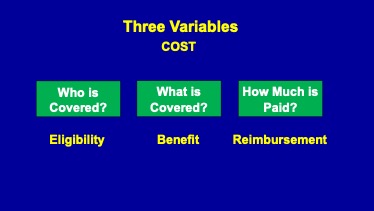
All public spending decisions involve three straightforward questions: (1) who is “covered,” or eligible, to receive a particular service, or “benefit,”: (2) what services, or “benefits,” will be covered, and (3) how much do those services cost—in this case, how much were we paying those who provide the services? Since each of these questions can be answered in a number of different ways, public resource spending decisions— including spending on health care—involve three variables: eligibility, benefit and cost.
In a zero-sum budget—that is, a budget with limited resources—a decision to spend money on one set of services or benefits is, at the same time, and decision not to spend those resources on other services or benefits. That means that there is a “hydraulic” relationship between these three variables.
Increasing eligibility in order to cover more people, will increase cost, unless benefits and/or provider reimbursement are reduced. Likewise, if benefits are increased, cost will also increase unless eligibility and/or provider reimbursement is reduced. And if provider payment is increased, cost will go up unless eligibility and/or benefits are reduced.
Since states, unlike the federal government, are constitutionally required to operate on a balance budget—a “zero sum” budget, if will. States cannot push their difficult political decisions into a national debt. The problem we were confronting in 1989 (and a problem that still exits today) was simply that legislators were using this hydraulic relationship to avoid directly confronting the reality of fiscal limits by manipulating these three variables—and, in the process, avoiding accountability for the inevitable human consequences of these decisions.
Therefore, the goal of the OHP was to create a more equitable, accountable and transparent way to make public health care spending decisions, that sought to get the greatest health benefit, for the largest number of people, with the resources we had available to spend our health care—as opposed to other public priorities like education or housing. Simply put, the OHP was a priority list and a budget box.
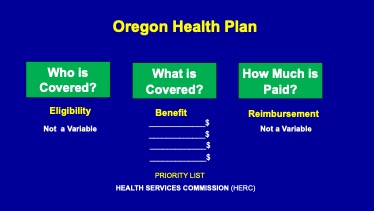
First, eligibility for the Medicaid program was set in statute at 100% of the federal poverty level, to ensure that eligibility could not be arbitrarily manipulated, as the E-Board had done in 1986.
Second, a Health Services Commission created (now the Health Evidence Review Commission) and charged with prioritizing health services from the most important to the least important, based on the relative health benefit for the entire population being served. Thus, Oregon was talking about “population health” several decades before it became part of the mainstream health policy debate.
This list was given to an independent actual firm which determined the cost of providing each benefit on the list. Both providers and consumers had input into the actuarial assumptions used in this process.
To carry out this charge, the Health Services Commission used “condition-treatment pairs” gleaned from the ICD (International Classification of Diseases) and CPT (Current Procedural Terminology) codes.All diagnostic procedures were covered, but treatments were ranked on the basis of a consideration of both clinical effectiveness and social values. This list—and its accompanying actuarial cost information—was then given to the legislature. In the case of a revenue shortfall, the legislature could no longer manipulate eligibility or cut provider reimbursement, which had been already been determined by the independent actuary.
In other words, eligibility and provider reimbursement were no longer variables, and the debate shifted from who is covered, to what is covered. Instead of debating which individual should receive a given service and which should be denied, we sought to ensure that everyone had access to health care, and then to debate the funding priority assigned to each specific health service, based its health benefit for the entire covered population.
The OHP was intended to create a “firewall” between the prioritization process—which we wanted to be objective and evidence-based—and the legislative resource allocation process which, by its very nature, is political. The legislature could not change the list as developed by the Health Services Commission. Instead, it made a resource allocation decision that determined the covered benefit, based on how much the list was funded.
It is important to note that the prioritized list was never intended to be a “cost containment” tool. Indeed, we have not “moved the line” for years. The list was designed not only to use evidence in developing the benefit, but also to ensure that the process was accountable. That is, we wanted to stop implicit rationing, and force the legislature to be held accountable—not only for what it chose to fund, but also for what is chose not to fund in the Medicaid benefit.
With the passage of the OHP in 1989, Oregon became the first state in the nation to honestly confront the reality of fiscal limits, and to create a more equitable, accountable and transparent way to allocate limited public resources for health care. Since then, it has benefited millions of Oregonians, both because of the expanded coverage and better reimbursement for providers, but also in the way the prioritized benefit was developed. But the plan took for granted the underlying delivery system and its financial incentives. It never really sought to address overall system cost, and it never connected the provision of health care to outcomes and quality. All that changed in 2011 with the creation of Coordinated Care Organizations. [See: How Oregon How Oregon Got the 1115 Waiver from the Clinton Administration to Implement the Oregon Health Plan].
In 2011, when I was sworn into my third term as governor, Oregon was in the depths of the Great Recession, with high unemployment and a budget deficit of $3.5 billion—over a third of which, was in Medicaid budget. It became clear that without replacement revenue, we would have to drop tens of thousands of Oregonians from coverage, or cut provider reimbursement rates nearly 40%. These were exactly the kinds of cost shifting mechanisms we were trying to get rid of in 1989, when we created the OHP. So, instead, we decided to focus on the Medicaid care model, to see if we could get more value for each dollar spent.
The result was the Coordinated Care Organization, or CCO. CCOs were new community-based organizations, with a local governing board, designed not only to provide high-quality health care those covered by the Medicaid program, but also to look beyond the clinical model and focus more broadly on community health.CCOs would operate on a budget linked to a sustainable growth rate, and would held accountable for metrics around quality and outcomes.
It is also very important to understand that CCOs were built on a spirit of partnership and sense of local ownership. Indeed, it was that collaboration—between CCOs themselves, and between CCOs and the Oregon Health Authority (OHA)—that formed the underpinnings for their early success.
In 2012, the Obama Administration gave Oregon the Section 1115 waivers needed to implement new care model—and a one-time, five-year $1.9 billion investment to help us make the transition from the old care model to the new one. In exchange, Oregon committed to reduce the Medicaid cost trend by two percentage points— from 5.4% to 3.4% per member per year—by the end of the second year of the waiver with no reduction in benefit or eligibility, and to meet rigorous quality and outcome metrics.
The waiver also granted CCOs flexibility within their budgets to provide services that are not generally considered medical—that is, services that do not have a “billing code.” For example, CCOs would be able to purchase a window air-conditioner in the summer for an elderly woman with congestive heart failure so that the temperature in her apartment does not get so high that her heart condition grows worse and requires hospitalization.
The original vision for CCOs, then, was to provide them with a budget, linked to a sustainable growth rate, and a set of outcomes—and to give each CCO broad flexibility on how to meet those outcomes and within that budget. The development of the CCO model was an experiment in collaboration between CCOs and the OHA, a partnership for innovation and system transformation.
During the first five-year waiver period, which ended in 2017, the state operated within the parameters of the 3.4% growth cap, all of the CCOs met the quality and outcome metrics stipulated in the waiver, we paid back the initial $1.9 billion federal investment, and realized a cumulative, total funds savings of over $1 billion. In short, we demonstrated that a locally designed and locally directed health care delivery model can maintain quality, expand access and reduce cost.
There were two main keys to success. The first was flexibility. Each CCO was granted flexibility to meet the key elements of the vision in a way that worked best for their community. This validated the fact that all health care is ultimately local.
The second key to success was a fixed budget that rewarded efficiency and created incentives for CCOs to reinvest savings into their communities to improve health. Indeed, the cost savings realized in the first five years were due to reducing the growth rate, not to reducing coverage or benefits, or cutting provider reimbursement. [See: How Oregon Got the 1115 Waiver from the Obama Administration to Implement the CCO Model].
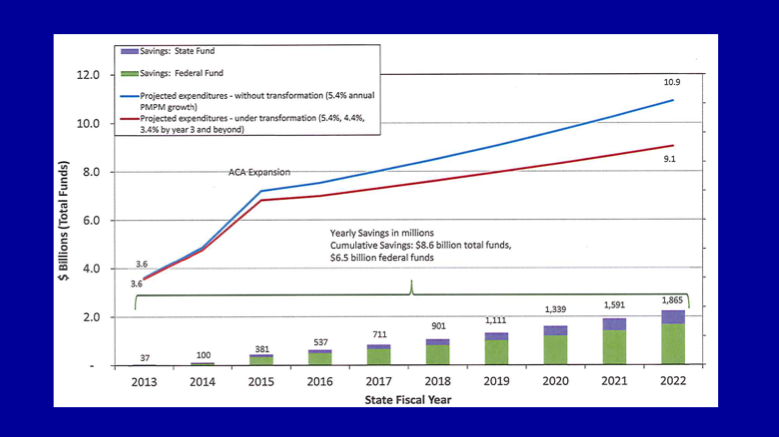
Today, Oregon’s framework of health system transformation faces four main challenges. First, we must repair the relationship between CCOs and the OHA, which has suffered from an increasingly regulatory environment. This has changed the relationship between CCOs and the OHA from a collaborative partnership in system transformation, to one that is top-down, regulatory, and at times punitive. Also, the time and energy required to comply with a growing regulatory superstructure, diverts time and resources away from direct patient care, innovation, and system transformation.
We must honestly put this issue on the table—not in a confrontational way—but out of a sincere desire to balance, flexibility with accountability, to rebuild a partnership for innovation and system transformation, and to create a clear, shared vision for Oregon’s health future.
Second, over the past eight years, we have we have moved away from a global budget and back toward traditional rate-setting based on actuarial soundness. We need to make a high priority of working with our federal partners to move back toward a true global budget that encourages innovation, creates fiscal sustainability and avoids the traditional response to cost increases: reducing coverage, benefits, and/or payment.
We need to press for a new rate-setting methodology that counts in the rate development process: (1) efforts to improve health outcomes, (2) efforts to improve community health, (3) efforts to support network development and capacity, and (4) the anticipated utilization of new services mandated, but not funded, by the OHA or the legislature.
Third, is the prioritized list. In 2022 discussions around renewing Oregon’s 1115 waiver for the Oregon Health Plan, OHA and CMS (Centers for Medicare & Medicaid Services) agreed to move the prioritized list out of the waiver and into the State Plan Amendment. It remains unclear exactly what problem is trying to be addressed by this move, but there is nothing in the transmittal letter from CMS to the OHA that suggests Oregon must stop using the list to develop the covered benefit, as we have been doing for thirty years.
As mentioned earlier, part of the problem is that there is no institutional memory in Oregon Health Authority, the Oregon Legislature, or within CMS, about why we created the list in the first place. The fact remains, that Oregon is the only state in the nation with this kind of transparent, public, accountable and evidence-based process to create a covered benefit—in a way that seeks get the greatest health benefit for the greatest number of Oregonians.
In other states, in the lack this kind of process, when big Pharma—or anyone else who wants their specific treatment covered— they go behind closed doors and beat up on the Medicaid Director until they cave in. That’s not public, that’s not transparent, that’s not accountable and that’s not evidence-based. Oregon should not back default to that kind of process, by letting go of what we have, without a very good reason. So far that reason is not clear.
Finally, is the relationship between CCOs and community health. As discussed earlier, a central part of the CCO mission was to move beyond the clinical model and focus more broadly on community health. This was an explicit recognition of the fact, that most of the factors that impact lifetime health status, occur outside the medical system and in the community—often in the very earliest years of life.Oregon has a long, proud history of health system transformation, dating back to 1989 with the creation of the Oregon Health Plan (OHP). For over 3o years, Oregon has been on the cutting edge of innovation, leading the nation in our willingness to challenge underlying assumptions, and to honestly explore the difficult questions involved with efforts to ensure access to health care in a world of finite resources.
Today, the framework of our health system innovation stands at a crucial point in its evolution.
We know from the science of brain development, that poor nutrition and maternal stress, both before conception and during pregnancy, can alter genetic expression in the unborn child, dramatically increasing the risk of poor cognitive functions, learning disabilities, mental health and substance use disorders and early adult onset of many chronic illnesses—from diabetes to cardiovascular disease. Science also tells us that the same factors that cause epigenetic change during pregnancy, put stress on families, leading to a well-documented set of “Adverse Childhood Experiences” that undermine the healthy early relationships so important to lifelong success.
While CCOs are tasked with investing in community health, they cannot do it alone. They need other partners—particularly Early Learning Hubs, which were intentionally created in 2012, at the same time we created CCOs. The original vision for our Early Learning Hubs, was to bring together multiple community partners, and to align services and resources to better meet the needs of children and families. The Hubs were intended to help provide a link between the CCOs and upstream community investment to address the social determinants of health.
No other state in the nation has this kind of community-based infrastructure which, for over a decade, has been building local capacity and trusted local relationships. The next key step health system transformation is to more fully resource and empower the Early Learning Hubs, and for CCOs and Hubs to form a closer collaboration. This collaboration will be intentionally focused on the first 1,000 days of life—from conception to age 2—during which over 80 percent of a child’s brain development takes place.
Oregon is exploring five “Demonstration Projects” to illustrate how such a collaboration might provide a powerful tool to more effectively address the root causes of childhood trauma and adverse experience—and the root causes of many chronic diseases. These Demonstration Projects are part of the First 1,000 Days Upstream Initiative, sponsored by the Oregon Health and Education Collaborative, a 501(c)(3) public benefit corporation, led by education and health care leaders from across the state.
These five projects are led by the Early Learning Hubs in Yamhill County, Marion and Polk Counties, Lane County, Josephine and Jackson Counites, the Blue Mountain Early Learning Hub in NE Oregon. Since last fall, they have been working with community partners—including their local CCOs—and engaging pregnant moms and families with young children—to develop locally designed and locally owned Child Success Models to address the root causes of maternal and family stress in the first 1,000 days of life. These Demonstration Projects can offer the blueprint for how a closer and more intentional relationship between these two well-established community-based organizations might be structured.
Conclusion
We have come a long way together. We have reached this point because we have approached the challenge of health policy in Oregon, through a commitment to collaboration, cooperation and bipartisanship. This was reflected in broad-based legislative support for both the OHP and our CCOs. Senate Bill 27, which created the OHP in 1989, passed the Senate with a vote of 30-0, and the House with a vote of 57-3. And in 2011, House Bill 3650, which created our CCOs, passed the Senate with a vote of 22-7, and the House with a vote of 57-1.
It is my hope, that this context and history of the evolution of Oregon’s current Medicaid delivery system and care model, will help inform the upcoming debate over the future of the Oregon Health Plan and Oregon’s Coordinated Care Organizations. By recommitting ourselves to a partnership in collaboration and innovation, we have the opportunity to move this 30-year odyssey to the next level, and reassume our position at the leading edge of the national health policy debate.
I am reminded of the words of Wallace Stenger, in his collection of essays The Sound of Mountain Water. He is describing the West, but he might well have been describing the Oregon Story of health system innovation.
“When it fully learns that cooperation, not rugged individualism is the quality that most characterizes and preserves it, then it will have achieved itself and outlived its origins. Then it has a chance to create a society to match its scenery.”


